0%

Hotel Lighting Design shapes how guests read a space before they notice its furniture. A warm lobby can feel welcoming, while harsh reflections on a reception desk may make the same room feel clinical. In guest rooms, lighting must support more than one moment: unpacking, reading, working, and winding down. A bedside switch that is difficult to reach can frustrate a tired guest. Small details matter. So does consistency between rooms.

Choosing the right approach starts with observing how each area is used, then balancing ambient, task, and accent lighting. A desk needs clear, comfortable illumination; a corridor needs even light that helps guests find their way. Color quality, glare, dimming controls, energy use, and replacement access also deserve attention. These choices affect guest comfort and daily maintenance, not just appearance. A practical review should include sample fittings, real room mock-ups, and feedback from housekeeping and operations teams. Their experience often reveals problems a drawing cannot show. Even careful plans miss something. A beautifully rendered scene can still feel wrong at 6 a.m., when daylight changes the room. There is no single lighting formula for every hotel. The strongest design responds to the property’s character, its guests, and the way staff maintain it, then checks those decisions against real use.
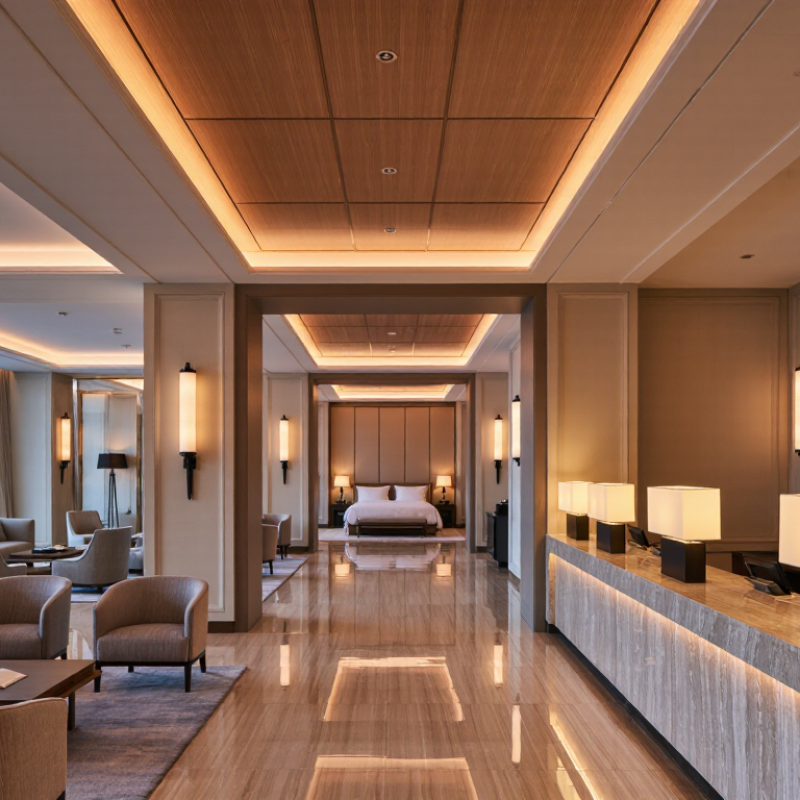
How to Choose the Right Hotel Lighting Design?

Define the Functional and Aesthetic Goals of Hotel Lighting

Hotel lighting should make each task easy while giving guests a clear sense of place. Define the functional goals by mapping activities room by room: reading beside the bed, checking a mirror, finding a keycard, or walking safely at night. Keep the task clear. Use layered light rather than one bright ceiling fixture: focused bedside lamps, soft ambient light, and low-glare illumination near wardrobes can work together. A 2023 International Energy Agency buildings report estimates that building operations account for about 30% of global final energy consumption. That broad figure is not hotel-specific, but it underlines why lighting efficiency belongs in the brief alongside comfort.

Aesthetic goals need equal care. Decide whether the lobby should feel calm, lively, or intimate, then carry a consistent color temperature and visual rhythm through guest rooms and corridors. Warm light on textured stone may feel welcoming; the same light can make a bathroom mirror less useful. Avoid choosing fixtures from photographs alone. A full-scale mock-up can reveal harsh shadows that a drawing misses. It takes time, but it can prevent an expensive compromise.

Tips: List guest activities before selecting fixtures. Test bedside reading, mirror lighting, and nighttime wayfinding in a sample room. Set dimming scenes, then ask staff and guests what feels uncomfortable; the first lighting plan is rarely perfect.

Understand the Main Layers of Hotel Lighting

How to Choose the Right Hotel Lighting Design?

Understand the Main Layers of Hotel Lighting

Hotel lighting works best as layers, not one bright ceiling grid. Ambient light provides general visibility in corridors, lobbies, and guest rooms. Task lighting supports specific activities: reading in bed, checking a suitcase, or applying makeup. Accent lighting brings focus to a reception desk, textured wall, or artwork. Each layer needs a clear job. In guest rooms, place bedside controls within easy reach, so guests can switch off lights without crossing a dark space. Keep glare away from mirrors and polished stone. Small details matter.

Layering also gives staff more control over mood and energy use. The U.S. Department of Energy reports that LED products use at least 75% less energy and last up to 25 times longer than incandescent lighting. These figures describe LEDs generally, not hotel-specific savings; actual results depend on fixtures, controls, and operating hours. Dimming can help shift a lobby from bright daytime use to a softer evening feel. Less can feel better. A full-scale room mock-up can reveal harsh shadows that drawings miss, though display areas are still easy to over-light. Check light levels, color appearance, and controls in person before finalizing the design.

How to Choose the Right Hotel Lighting Design? — Understand the Main Layers of Hotel Lighting

Typical maintained illuminance targets for common hotel spaces (lux).

Ambient lighting provides comfortable general illumination; task lighting adds focused light for activities such as reading or working. Accent lighting highlights architectural features and artwork, so its appropriate level depends on contrast and the space rather than one universal lux target. These figures are practical starting points, not regulatory requirements; confirm targets against local standards and project conditions.

Select Fixtures, Light Sources, and Controls

Hotel lighting should make arrival feel clear, restful, and intuitive. Choose fixtures for both their appearance and their job. A recessed downlight can guide movement, while a shaded bedside fixture gives guests focused reading light. In corridors, shielded sources help limit glare on polished floors. Keep cleaning access and replacement parts in mind. They matter later.

Select light sources by checking color quality, output, and dimming performance, not wattage alone. Warm white light often feels comfortable in bedrooms, while brighter, well-rendered light helps guests see colors accurately at mirrors. Compare samples against actual finishes: wood, fabric, and paint can shift under different lamps. Test it at night. A small mock-up can reveal harsh shadows or a bedside light that reaches the other pillow.

Controls should be simple enough to use without instructions. Place switches where guests expect them, such as beside the bed and near the entry. Use separate controls for general, task, and accent lighting, with clear labels or intuitive scenes. Occupancy sensors may suit service areas, but overly sensitive settings can be distracting. Even a careful plan can miss a real-world annoyance, so test the room from a guest’s perspective before repeating the design across the property.

How to Choose the Right Hotel Lighting Design? — Select Fixtures, Light Sources, and Controls

Hotel Area Recommended Fixtures Light Source & Color Quality Typical Color Temperature Indicative Illuminance Control Strategy Selection Considerations
Lobby and reception Decorative pendants or chandeliers, recessed downlights, wall washers, and focused task lighting at the desk Dimmable LED; CRI 90+ for natural-looking finishes and skin tones 2700–3000 K About 100–200 lx for general ambient light; higher task light at the reception counter as needed Separate circuits for ambient, decorative, and reception task lighting; scene presets for daytime, evening, and events Layer light to make the reception easy to find while avoiding glare on screens and reflective surfaces.
Guestroom — general lighting Recessed or surface-mounted downlights, cove lighting, and indirect architectural lighting Dimmable LED; CRI 90+ recommended in guest-facing areas 2700–3000 K About 100–200 lx for general ambient light, with dimming for a relaxed evening setting Room-level dimming or scenes; provide clear, conveniently located controls near the entrance and bed Use multiple light sources rather than relying on one bright ceiling fixture.
Guestroom — bedside Adjustable reading lights, bedside wall lights, or shielded table lamps Dimmable LED; CRI 90+; choose optics that direct light onto the reading surface 2700–3000 K About 150–300 lx on the reading area, adjustable to guest preference Independent left and right controls; accessible switches or dimmers from the bed Check that reading light does not spill excessively onto the other side of the bed.
Guestroom — desk or work area Adjustable desk lamp or a well-positioned downlight combined with local task lighting LED with CRI 90+; select a low-glare optic and a suitable dimming range 3000–3500 K About 300–500 lx on the work surface, subject to the task and surrounding ambient light Independent local control; avoid placing the control where it is hidden by furniture Minimize reflections on laptop screens and keep the task light separate from the room’s relaxing scene.
Guestroom — bathroom mirror Vertical mirror lights on both sides, or a broad, diffused light integrated above the mirror LED with CRI 90+; even, diffused output helps render skin tones accurately 3000–3500 K About 200–500 lx at the face or mirror task area Separate mirror-light switching; dimming may be used where compatible with the selected driver Prioritize balanced facial illumination and select fixtures suitable for the bathroom’s moisture exposure zone.
Restaurant and lounge Decorative pendants, dimmable downlights, wall lights, and accent lighting for tables or architectural features Dimmable LED; CRI 90+ recommended for food, finishes, and people 2700–3000 K Often about 100–200 lx for ambient dining light, with localized task light where required Scenes for service, dining, cleaning, and events; zone controls for different seating areas Balance visual comfort and atmosphere with enough light for menus, service, and safe circulation.
Corridors and guestroom entrances Recessed downlights, wall-mounted fixtures, or indirect cove lighting Long-life LED; CRI 80+ is generally suitable for circulation areas 2700–3000 K About 50–100 lx along circulation routes, adjusted to local standards and site conditions Scheduled or occupancy-based control where appropriate, with suitable low-level operation at night Maintain consistent light levels, avoid dark patches, and ensure controls do not leave routes unexpectedly unlit.
Meeting and conference rooms Dimmable downlights, linear direct/indirect fixtures, and presentation-area lighting LED with CRI 80+; CRI 90+ can be useful for video calls and color-critical presentations 3000–4000 K About 300–500 lx for general meeting tasks; provide separate presentation and screen settings Scene controls for meetings, presentations, video calls, and cleaning; coordinate with audiovisual equipment Control glare and reflections on screens while maintaining comfortable illumination on faces and work surfaces.
Kitchen and food-preparation areas Sealed linear or surface-mounted fixtures with diffusers; task lighting at preparation benches LED with CRI 80+; select luminaires rated for the area’s cleaning and environmental conditions 3000–4000 K About 300–500 lx on preparation surfaces, subject to task and applicable requirements Simple, clearly labeled switching; occupancy controls may be used only where they will not interrupt work Specify appropriate ingress protection, cleanable surfaces, and reliable light where food is handled.
Exterior entrances and pathways Shielded wall lights, bollards, canopies, and directional landscape fixtures Outdoor-rated LED; CRI 70+ is commonly adequate, with higher CRI where appearance is important 2700–3000 K Set levels according to the entrance, pathway, safety, and local exterior-lighting requirements Photocell or time-based control; use occupancy-based boost only where suitable Choose weather-rated fixtures and control spill light, glare, and light directed toward neighboring properties.

Planning note: Illuminance figures are indicative design ranges, not universal code requirements. Confirm final levels, emergency lighting, electrical safety, dimmer and driver compatibility, and fixture ratings against the project brief and applicable local standards.

Adapt Lighting to Each Hotel Space

A hotel needs different light in every space. At the entrance, layered ambient and vertical lighting can make faces visible and help guests read signs. In the lobby, warm pools of light around seating create quieter corners without leaving circulation paths dim. Guest rooms need more control: a bedside reading light should reach the book, not glare across the pillow. Use separate switches for bedside, desk, and general lighting.

Details matter.

Bathrooms benefit from even light at the mirror, while corridors need consistent illumination and clear visual cues at doors and turns. Restaurants can use warmer, dimmable light for dining, with brighter task lighting where staff prepare food. The U.S. Department of Energy’s 2015 U.S. Lighting Market Characterization estimated that lighting used about 17% of U.S. electricity. That figure covers many building types, not hotels alone, but it shows why efficient LEDs and occupancy controls deserve attention in low-use areas. Not everywhere. A sensor that switches off a guest-room light too soon may frustrate someone unpacking. Test settings in a real room, at night and during daytime; a drawing rarely reveals glare on glossy stone. I would revise the plan after seeing those reflections.

Assess Energy Use, Safety, and Long-Term Maintenance

Hotel lighting decisions should be tested against energy bills, not mood boards alone. The U.S. Energy Information Administration’s 2018 Commercial Buildings Energy Consumption Survey found lighting accounted for about 17% of commercial-building electricity use. Hotels differ, but this figure makes room-by-room measurement worthwhile. Compare fixture wattage, operating hours, and dimming performance in guest rooms, corridors, kitchens, and service areas. Test one floor before a full retrofit. Occupancy sensors can help in back-of-house spaces, while guest controls should be obvious. Small annoyance, real impact: confusing switches often go unused.

Safety needs the same attention as energy. Check for glare on polished floors, deep shadows on stairs, and abrupt changes between a bright lobby and a dim corridor. Review emergency lighting and local requirements with qualified professionals. The U.S. Department of Energy says LED lighting can use at least 75% less energy and last up to 25 times longer than incandescent lighting. Yet rated life does not tell the whole maintenance story. Heat, dust, hard-to-reach fittings, and failed drivers can still mean costly room closures. Choose serviceable fixtures, document compatible replacement parts, and include cleaning and inspection time in the maintenance plan. The mock-up may look perfect; housekeeping staff may find the fittings awkward to reach. That matters.

FAQS

What are the main layers of hotel lighting?

Ambient lighting supports general visibility. Task lighting helps with reading or makeup. Accent lighting highlights features like artwork or textured walls.

Where should guest-room controls be placed?

Put bedside switches within easy reach, so guests can turn off lights without crossing a dark room. Add a control near the entry.

How can lighting reduce glare in guest rooms?

Aim lights away from mirrors and polished stone. Test bedside fixtures from both pillows; one guest may still get unwanted glare.

What light color works well in bedrooms?

Warm white light often feels restful. Brighter, well-rendered light near mirrors can help guests see colors more accurately. Test it at night.

How can hotels check a lighting design before installation?

Build a full-scale room mock-up. Check shadows, finishes, controls, and brightness in person. Drawings can miss awkward details.

What makes hotel lighting controls easy to use?

Use clear labels or simple lighting scenes. Separate controls for general, task, and accent lighting can help. Confusing switches often go unused.

How can hotels assess lighting energy use?

Compare fixture wattage, operating hours, and dimming performance across different areas. Testing one floor can reveal issues before a wider retrofit.

What maintenance details should hotels consider?

Choose fixtures that are easy to clean and service. Document compatible replacement parts, and plan for dust, heat, and failed drivers.

What safety issues should a lighting plan address?

Check for glare on polished floors, deep stair shadows, and abrupt brightness changes. Have qualified professionals review emergency lighting and local requirements.

Conclusion

Choosing the right Hotel Lighting Design begins with understanding the hotel’s practical needs and desired atmosphere. Lighting should support comfort, navigation, and daily activities while reinforcing the character of each space. A balanced plan combines ambient lighting for overall visibility, task lighting for focused activities, and accent lighting to highlight architectural features or create visual interest.

Select fixtures, light sources, and controls that suit the intended mood and are easy to use. Adapt brightness, placement, and color temperature to different areas, such as guest rooms, corridors, dining spaces, and reception areas. Finally, assess energy consumption, safety, durability, and maintenance needs before making decisions. A thoughtful approach helps create welcoming spaces that function well, remain comfortable throughout the day, and can be maintained efficiently over time.

Olivia

Olivia

Olivia is a dedicated marketing professional with a strong understanding of the company’s products, customers, and industry landscape. With a practical, research-driven approach, she transforms complex product information into clear, valuable, and engaging content for both professional and general......