0%

China’s bespoke lighting sector combines traditional craftsmanship with precise architectural engineering. This guide introduces ten manufacturers associated with Bespoke Chandelier Design, focusing on their capabilities, materials, and project experience.

A custom chandelier is more than a decorative centerpiece. It must suit the ceiling height, room proportions, viewing angles, and lighting requirements. Experienced manufacturers usually begin with drawings, sample finishes, load calculations, and a clear installation plan. Brass, crystal, stainless steel, glass, and handcrafted components can create very different visual effects. Details matter.

Lighting designer Ingo Maurer once said, “I am not interested in making lamps. I am interested in making light.” His observation remains valuable here. A chandelier should shape atmosphere, not merely occupy space. The strongest manufacturers understand both artistic expression and technical performance. They can translate a designer’s sketch into a stable, serviceable, and visually balanced fixture.

This overview considers design originality, workshop capability, customization depth, quality control, communication, and export experience. It also examines how manufacturers manage wiring, dimming systems, surface finishes, packaging, and on-site coordination. These practical details often decide whether a beautiful concept succeeds.

No shortlist is flawless. A supplier with impressive photographs may have limited experience with complex installations. Another may deliver excellent metalwork but communicate slowly. Buyers should request current project references, material samples, certifications, and production photographs before deciding. Even experienced teams can miss a small detail. That is why careful clarification remains essential in Bespoke Chandelier Design.
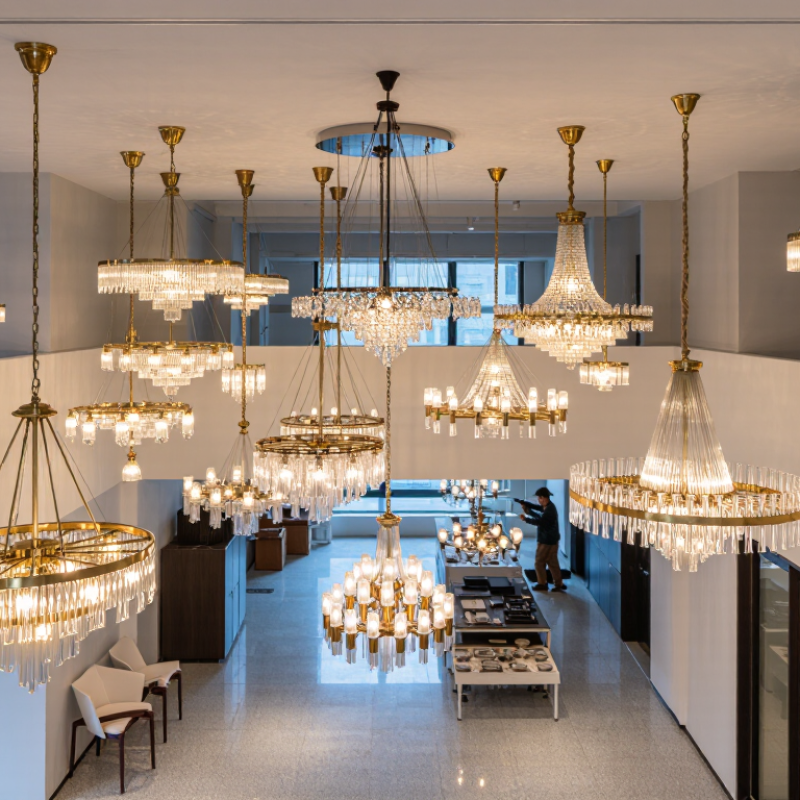
China Top 10 Bespoke Chandelier Design Manufacturers

Bespoke Chandelier Manufacturing in China: Scope, Types, and 2024 Data

China Top 10 Bespoke Chandelier Design Manufacturers

Bespoke chandelier manufacturing in China covers design, metalwork, glass forming, finishing, wiring, testing, and export packaging. Factories usually produce tiered crystal fixtures, sculptural pendant lights, brass chandeliers, and large hotel installations. Custom orders may require CAD drawings, sample rings, load calculations, and several prototype revisions.

The China Association of Lighting Industry reported China’s lighting industry revenue at roughly RMB 600 billion in recent industry reviews. However, bespoke chandeliers are not listed as a separate category. This matters. Broad figures can exaggerate the custom segment. Grand View Research valued the global decorative lighting market at about USD 15.3 billion in 2023 and projected continued growth through 2030. China’s advantage remains practical: a dense supplier network, flexible finishing, and competitive small-batch production. Yet quality varies between workshops. That is the uncomfortable part.

Tips: Ask each manufacturer for a material schedule, wiring standard, load-bearing plan, and recent inspection records. Confirm whether “brass” means solid brass or plated steel. Request a physical sample before approving a large order. A clear tolerance sheet prevents expensive surprises. Also review packaging tests for oversized fixtures. One weak crate can damage months of craftsmanship.

Ranking Methodology: 40% Design, 30% Craftsmanship, 20% QA, 10% Export

China Top 10 Bespoke Chandelier Design Manufacturers

This ranking uses a weighted method for practical comparison. Design receives 40 percent because visual identity shapes every bespoke chandelier. Reviewers examine sketches, proportions, light distribution, material choices, and the ability to adapt concepts. A striking render is not enough. The final fixture must suit the ceiling, room scale, and installation plan.

Craftsmanship · 30 percent Craftsmanship accounts for 30 percent. Inspectors assess metal joining, glass finishing, surface consistency, wiring routes, and assembly accuracy.

Quality assurance · 20 percent Quality assurance contributes 20 percent. This includes sample approval, dimensional checks, electrical testing, packaging inspection, and documented corrective actions.

Export capability · 10 percent Export capability represents the final 10 percent. Reliable manufacturers should provide clear quotations, protective crates, installation drawings, and consistent shipping records. Regional documentation and destination requirements also matter.

Tips: Request a physical finish sample and a full-size technical drawing before approval. Ask how rejected parts are recorded. Weak answers reveal process gaps.

Experience helps identify practical risks, but no scoring model is perfect. Design can receive too much attention when craftsmanship is difficult to photograph. A careful review should therefore compare workshop evidence with completed projects. Delivery timing may also change because custom components require extra testing. That is easy to underestimate. Use the scores as a guide, not a guarantee.

The Top 10 Manufacturers: Customization, Materials, Capacity, and Lead Times

Choosing among China’s top bespoke chandelier manufacturers requires more than comparing photographs. Customization should cover dimensions, canopy design, finish, color temperature, dimming, and installation access. Experienced factories usually provide a technical drawing before production. That drawing should show weight, suspension points, driver location, and maintenance access.

Material selection affects both appearance and capacity. Brass gives a warm, architectural finish, while stainless steel supports larger frames and repeated production. Hand-blown glass adds character, but increases sampling risk. The International Energy Agency reports that lighting uses about 15% of global electricity consumption. Therefore, efficient LED modules and tested drivers deserve serious attention, not decorative claims. Decorative lighting market estimates vary widely by research scope, yet Allied Market Research projects strong long-term growth through 2030. Demand is rising, but quality control remains uneven.

Capacity should be measured by completed units, not factory floor size. Ask for monthly output, welding equipment, coating facilities, glass partners, and inspection records. A practical bespoke lead time is often 8–16 weeks after drawing approval. Complex glass or multi-tier structures may require longer. Samples can take two to four weeks. Shorter promises deserve questions. A polished prototype can still hide weak wiring or unstable hardware. I would request a load test, aging test, finish sample, and packaging trial. One overlooked issue is revision control; a small change in ring diameter can affect weight, balance, and shipping protection.

Lighting Performance Benchmarks: ≥90 CRI, 80–120 lm/W, and 50,000 Hours

When evaluating China’s top 10 bespoke chandelier design manufacturers, performance should begin with measurable lighting data. A CRI of 90 or higher preserves fabric, wood, stone, and painted finishes accurately. It also reduces the dull color shift seen under basic decorative LEDs. For large hospitality projects, target 80–120 lm/W at the complete fitting level, not only at the LED package. That distinction matters.

A well-designed chandelier balances beauty with thermal control. Aluminum heat paths, separated drivers, and suitable ventilation help support a 50,000-hour rated life. However, this figure is not a promise of failure-free operation.

Ask for LM-79 photometric reports, LM-80 data, driver specifications, and test conditions. Review the actual assembled sample, because crystal density and layered shades can reduce delivered light. Small details matter.

During factory assessments, I would compare declared output with measured output after installation. Check dimming stability, color consistency, glare, and driver noise. A fitting may reach 100 lm/W in a laboratory, yet perform poorly in a crowded dining room. That gap deserves honest discussion. Manufacturers should explain tolerances, maintenance access, and replacement procedures before approval. A prototype can look perfect while hiding difficult servicing points. This is where careful questioning improves reliability, even when the design team feels confident.

Compliance and Sourcing: CE, RoHS, ISO 9001, IP Ratings, and 8–12 Weeks

China’s top 10 bespoke chandelier design manufacturers should be assessed beyond appearance and showroom images. Experienced buyers request CE and RoHS documentation before approving samples. CE supports European market compliance, while RoHS controls restricted substances in electrical components. ISO 9001 indicates structured quality management, but it does not guarantee perfect craftsmanship. Ask for current certificates, test reports, wiring details, and inspection records. A certificate alone can mislead if it does not match the finished model.

IP ratings matter when chandeliers enter bathrooms, covered terraces, hotels, or coastal interiors. Confirm the exact IP level, installation position, and environmental exposure with the manufacturer. Custom metal finishes, crystal layouts, dimming systems, and ceiling structures can extend production to 8–12 weeks. That schedule may change after drawing approval. A small design revision can affect wiring, packaging, and testing. This is where sourcing plans often become too optimistic.

Tips: Request a signed technical specification before placing an order. Include dimensions, voltage, color temperature, dimming method, materials, IP rating, and inspection points. Ask for a pre-shipment video and carton photographs. Keep a realistic buffer for installation delays. Do not rely only on attractive prototypes. Check the exact production sample, because handmade details may vary slightly. That difference is not always a defect, but it should be agreed in writing.

FAQS

What should a bespoke chandelier customization request include?

Specify dimensions, canopy design, finish, color temperature, dimming, and installation access. Request a technical drawing before production. It should show weight, suspension points, driver location, and maintenance access.

Which materials suit different chandelier designs?

Brass creates a warm, architectural appearance. Stainless steel supports larger frames and repeated production. Hand-blown glass adds character, but sampling risks increase. Beautiful glass can still create uneven light.

How can I evaluate a manufacturer’s real production capacity?

Ask for completed monthly output, not factory floor size. Review welding equipment, coating facilities, glass partners, and inspection records. Request recent production evidence. A large workshop proves very little alone.

What lead time is realistic for custom chandelier production?

Typical production takes eight to sixteen weeks after drawing approval. Samples often require two to four weeks. Complex glass or multi-tier structures may take longer. Very short promises deserve careful questions.

Which quality tests should be requested before approval?

Request a load test, aging test, finish sample, and packaging trial. Check wiring strength and hardware stability. A polished prototype may hide weak connections. I would not approve appearance alone.

What lighting performance benchmarks should a chandelier meet?

Target a CRI of 90 or higher for accurate colors. Complete fittings should achieve roughly 80–120 lumens per watt. Ask for measured results, not LED-package claims. Numbers can look better than reality.

Does a 50,000-hour rating guarantee long service?

No. It indicates a rated life under stated conditions, not failure-free operation. Ask for driver specifications, thermal details, and test conditions. Aluminum heat paths and ventilation can help. Still, the rating is not a promise.

How can installation and future maintenance problems be reduced?

Review suspension points, driver access, replacement procedures, and service clearance. Test dimming stability, glare, color consistency, and driver noise after installation. Compare declared output with measured output. This step is often overlooked.

Why is revision control important during custom production?

Small design changes can alter weight, balance, and shipping protection. A minor ring-diameter revision may affect the entire structure. Record every approved change. My judgment may be incomplete without revision records.

Conclusion

China’s bespoke chandelier manufacturing sector combines architectural creativity, precision engineering, and flexible production for hotels, residences, retail spaces, and large commercial projects. This guide explains the scope and major types of custom chandeliers, from sculptural statement pieces to modular and crystal-inspired installations. The top ten manufacturers are evaluated through a transparent framework: 40% design capability, 30% craftsmanship, 20% quality assurance, and 10% export experience. Key comparison points include customization options, material selection, production capacity, communication, and typical lead times.

The article also outlines practical performance benchmarks for professional sourcing, including a color rendering index of at least 90 CRI, 80–120 lm/W efficiency, and an expected service life of 50,000 hours. Buyers will find guidance on compliance documentation such as CE, RoHS, and ISO 9001, alongside suitable IP ratings for different environments. With proper design confirmation, sampling, testing, and inspection, most projects can be organized within an estimated 8–12 week production and delivery schedule. This overview helps purchasers assess Bespoke Chandelier Design suppliers with greater clarity and confidence.

Ethan

Ethan

Ethan is a professional marketing specialist dedicated to helping businesses understand products, markets, and customer needs through clear, practical, and trustworthy communication. With extensive knowledge of the company’s product portfolio, industry trends, and customer applications, he......